Key takeaways
- Sorbates inhibit yeast. In a yeast-raised bread they would interfere with fermentation and rise, so bread bakers generally use calcium propionate, which controls mold with little effect on yeast.
- Tortillas are not yeast-raised: flour tortillas are typically chemically leavened and corn tortillas are unleavened. Sorbic acid or potassium sorbate fits them well, often alongside propionate.
- Tortilla makers commonly add an acidulant such as fumaric acid to lower pH, because sorbate only works in its acid form.
Two preservatives, two jobs
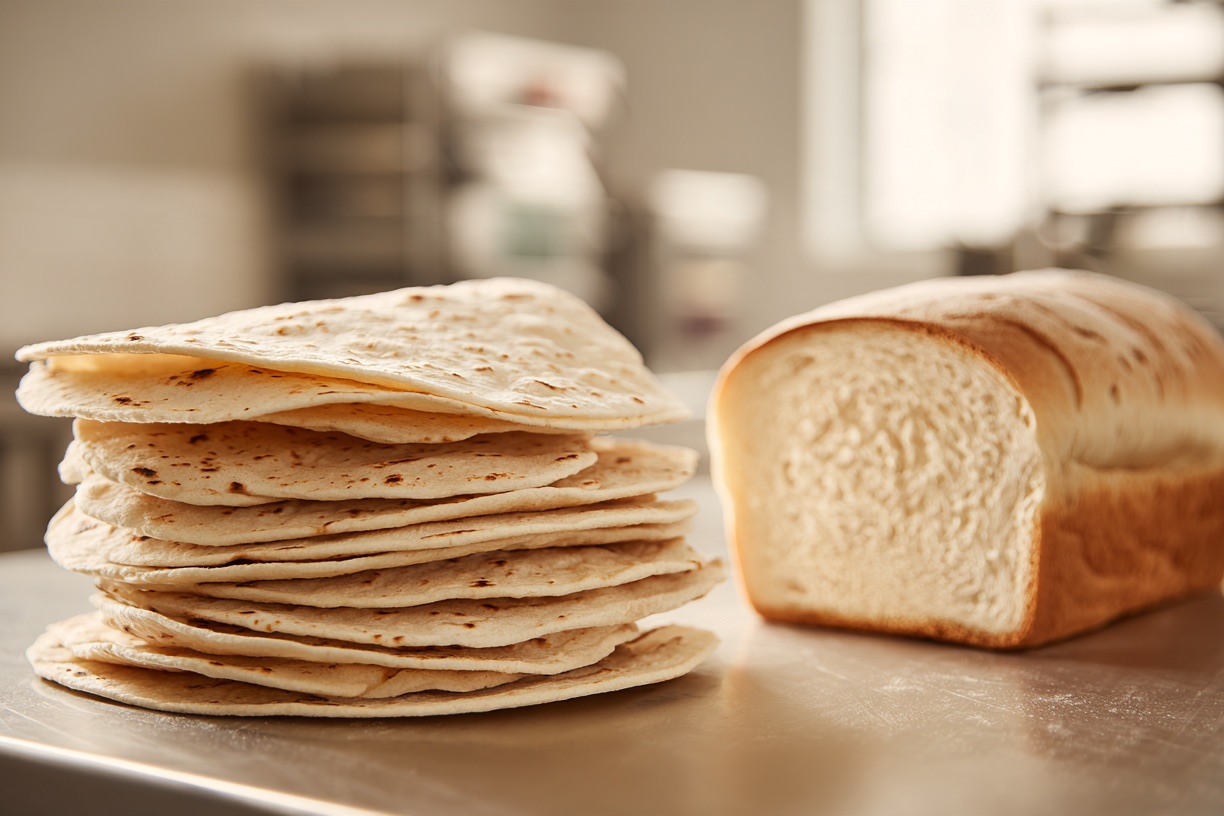
Walk through a bread bakery and a tortilla plant and you will find different preservatives on the ingredient lists. Bread leans on calcium propionate. Tortillas lean on sorbate, usually with propionate alongside. The reason is not habit. It comes from what each preservative does to yeast.
Sorbates, meaning sorbic acid and potassium sorbate, inhibit mold and yeast. Calcium propionate controls mold with little effect on yeast. For most foods the difference is academic. For anything that has to rise on yeast, it is decisive.
Bread: protect the yeast
A yeast-raised bread depends on live yeast fermenting the dough and producing the gas that gives the loaf its volume and crumb. Add a sorbate to that dough and the preservative does exactly what it is designed to do: it inhibits the yeast. Fermentation slows and the rise suffers.
That is why bread bakers generally use calcium propionate. It holds mold back in the finished loaf while leaving the yeast to do its work in the dough. The choice is made by the process, before anyone compares preservatives on price or strength.
What a baker would see is the consequence of that interference: a dough that proofs more slowly and a loaf with less volume than the same recipe without the sorbate. No preservative is worth that in a product whose whole character comes from the rise.
Tortillas: no yeast to protect
Tortillas are not yeast-raised. Flour tortillas are typically chemically leavened, and corn tortillas are unleavened. With no fermentation to protect, the main argument against sorbate disappears, and its strength against mold and yeast becomes an advantage.
So sorbic acid or potassium sorbate fits tortillas well. In practice it is often used alongside propionate rather than instead of it, which gives the product two preservatives that work in different ways.
Which sorbate form to use follows the usual rule. Potassium sorbate dissolves in water and goes in with the dough water. Sorbic acid suits a dry premix blended with the flour.
Why tortilla makers add an acidulant
Sorbate only works in its acid form, and the share of it in that form depends on the pH of the finished product. Below about pH 6 it works, and it gets much stronger as pH drops. That is why tortilla makers commonly add an acidulant, such as fumaric acid: it lowers the pH of the dough so the preservatives can work.
The scale of the effect is large. At pH 4 about 85 % of the sorbate is in its active form; at pH 6 about 5 %. The same dose can therefore be effective or nearly useless depending on where the finished product sits, which is why the acidulant is not an optional extra.
The practical consequence for QA is that the acidulant and the preservative are one system. Changing the acidulant level, the leavening or the recipe water can move the finished pH and quietly change how much of the sorbate is active. The pH of the finished tortilla is the number to track, batch by batch.
Other places sorbate fits in a bakery
The same logic extends beyond tortillas. Any bakery product that is not raised on yeast can use sorbate without the fermentation problem:
- Fillings
- Icings
- Fondant
- Cake-type products
In these products the preservative usually sits in a sweet, water-containing or fat-based phase rather than in a dough, so the choice between potassium sorbate and sorbic acid follows solubility: the salt for water phases, the acid for dry blends and fat-based systems.
At a glance
| Product | Leavening | Usual preservative | Why |
|---|---|---|---|
| Yeast-raised bread | Yeast fermentation | Calcium propionate | A sorbate would inhibit the yeast and the rise |
| Flour tortillas | Typically chemical | Sorbic acid or potassium sorbate, often with propionate | No yeast to protect; an acidulant lowers the pH |
| Corn tortillas | Unleavened | Sorbic acid or potassium sorbate, often with propionate | No yeast to protect; an acidulant lowers the pH |
| Fillings, icings, fondant, cake-type products | None or chemical | Sorbate; salt for water phases, acid for dry or fat-based | Not yeast-raised |
A short checklist for tortilla QA
- Measure the pH of the finished tortilla on every batch, not the dough water or the premix.
- Confirm the acidulant dose whenever the recipe, the leavening or the water changes.
- Choose the sorbate form by how it is added: potassium sorbate in the dough water, sorbic acid in a dry premix.
- Repeat the shelf-life test after any change to the preservative, the acidulant or the pH.
Frequently asked questions
- Can I use sorbate in a yeast-raised flatbread?
- The bread logic applies. If the product rises on yeast, a sorbate in the dough will inhibit that yeast. Propionate is the usual choice there, and any change should be tested on the line.
- Do tortillas need both sorbate and propionate?
- Many formulations use both, because the two work in different ways. Whether yours needs both depends on your target shelf life and must be shown by a shelf-life test.
- Why does my sorbate seem to do nothing in a tortilla?
- Check the finished pH first. If it is near 6 or above, most of the sorbate is not in its active form, and an acidulant will do more than extra preservative.