Key takeaways
- Mono- and diglycerides are emulsifiers made from food fats. In doughs they slow staling by binding to starch, which keeps tortillas soft and flexible for days longer.
- In icings, fillings and dairy products they hold fat and water together and trap air, giving volume, a smooth texture and stability on the shelf.
- Distilled monoglycerides are the concentrated grade; standard mono- and diglycerides the economical one. Both are GRAS in the United States under 21 CFR 184.1505.
What they are
Fats are glycerol carrying three fatty acids. Mono- and diglycerides are glycerol carrying one or two. That leaves part of the molecule attracted to water and part to fat, which is what makes an emulsifier: it sits at the boundary between the two and keeps them from separating.
They are made from vegetable or animal fats, sold as beads, flakes or powders, and are generally recognized as safe in the United States under 21 CFR 184.1505. Their E number is E471. On a label they appear as “mono- and diglycerides”.
In tortillas: softness and rollability
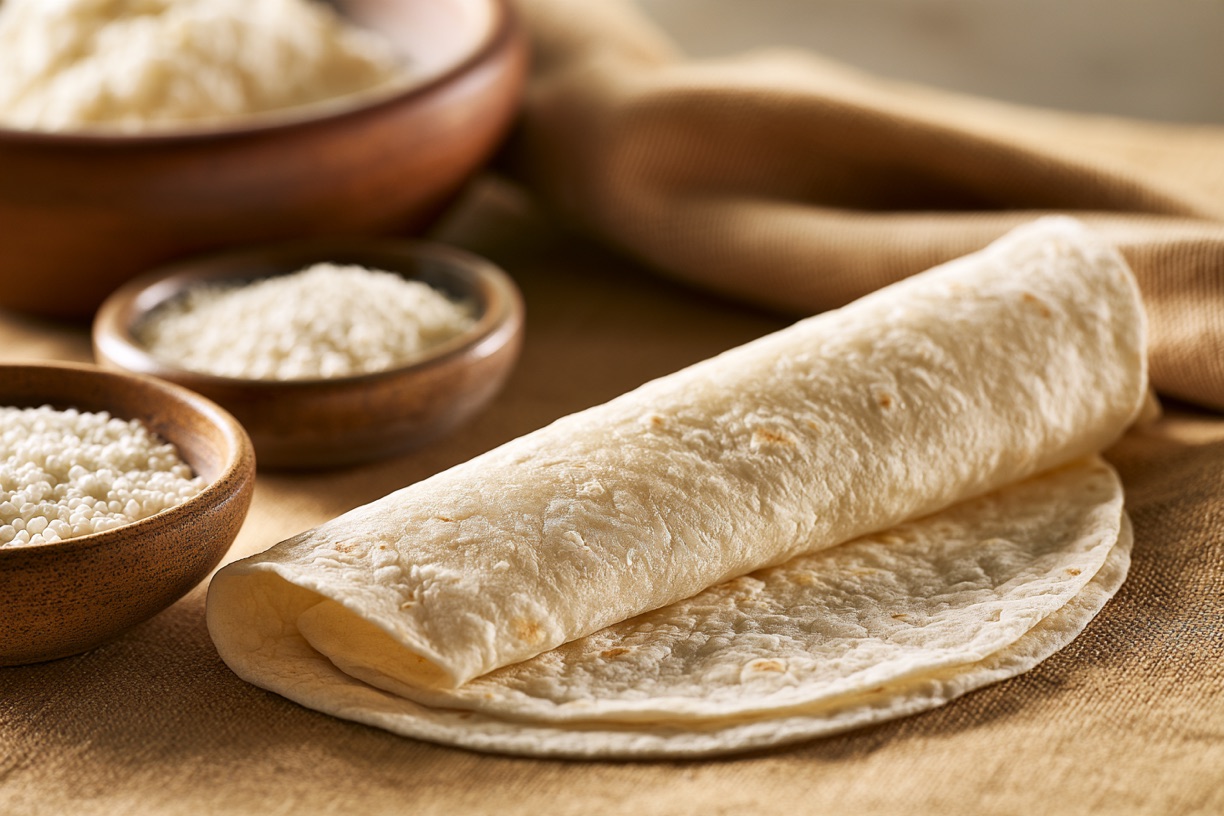
A tortilla goes stale the same way bread does: the starch that gelatinized in baking slowly recrystallizes as it cools and ages, and the product turns firm and brittle. Monoglycerides interfere with that. They form a complex with the starch during baking that slows the recrystallization, so the tortilla stays soft and folds without cracking for longer.
That is the property tortilla makers buy them for. A flour tortilla has to survive sheeting, pressing, baking, cooling, stacking and a week or more in a bag, and then roll around a filling without splitting. The emulsifier is a large part of why that works. It also improves dough handling and reduces sticking on the press.
Typical use is a fraction of a percent of the flour weight, and the hydrated form of the emulsifier is more effective than dry addition, which is why some plants disperse it in warm water before it meets the dough.
In icings, fillings and dairy: air and stability
An icing or a whipped filling is fat, sugar, water and air. Without an emulsifier the fat and water separate and the air escapes. Mono- and diglycerides sit at the fat-water boundary and at the surface of the air bubbles, so the icing takes more air, holds it, and stays smooth rather than greasy or grainy.
The same job turns up in ice cream and cultured dairy, where the emulsifier controls how fat is distributed and gives a creamier, more stable product. It is also used in cake-type products for volume and a finer crumb.
How it is added matters as much as how much. In an icing or a filling the emulsifier is melted into the fat or dispersed in the warm water phase before whipping; added cold as beads it stays as specks and does nothing. Use levels are usually a fraction of a percent to a few percent of the fat phase, set by the air the batch holds and how the product stands after a day.
Standard or distilled
| Standard mono- and diglycerides | Distilled monoglycerides | |
|---|---|---|
| Monoglyceride content | Lower; a mixture of mono-, di- and some triglycerides | High; concentrated by distillation |
| Effect per kilogram | Lower | Higher |
| Cost per kilogram | Lower | Higher |
| Where used | Icings, fillings, general bakery | Tortillas and bread where anti-staling matters most; ice cream |
| Forms | Beads, flakes, plastic | Beads, flakes, powder, hydrated gel |
Only the monoglyceride does the anti-staling work, so compare grades on monoglyceride content, not on weight.
Grades also differ in the fat they are made from. Fully hardened bases give firm beads with a high melting point and good heat stability; softer bases give flakes that disperse at lower temperatures. The right base depends on whether the emulsifier meets a hot fat, a warm water phase or a cold dough.
Reading the specification sheet
Four lines matter. Monoglyceride content tells you how much active emulsifier you are buying. Iodine value tells you how saturated the fat base is: low iodine value grades are harder and more heat stable, higher ones softer. Melting point tells you how the product will behave in the mixer and whether it needs to be melted or dispersed. Free glycerol and acid value are purity checks.
The fat source is a labeling and certification question as much as a technical one. Vegetable-based grades are the norm for products that carry vegetarian, kosher or halal claims; ask for the statement that goes with the grade.
A short checklist
- Buy on monoglyceride content; a distilled grade at a lower dose often beats a standard grade at a higher one.
- For tortillas, trial the hydrated form against dry addition and measure flexibility after one and two weeks.
- For icings, set the dose by the air the batch holds and how it stands after a day at room temperature.
- Match the melting point to your process so the emulsifier is dispersed, not left as beads.
- Specify the fat source and the certification statements you need on the purchase specification.
Frequently asked questions
- Are mono- and diglycerides vegan?
- They can be made from vegetable or animal fats. Most food-grade grades are vegetable based, but the only way to know is the supplier’s statement for the specific grade.
- Can I replace them with lecithin?
- Lecithin is an emulsifier too, but it does not complex with starch the way monoglycerides do, so it does not give the same anti-staling in tortillas. The two are often used together.
- How much do I use in a tortilla?
- A fraction of a percent of flour weight is the usual range, set by trial against the shelf life you need. Start at the supplier’s recommendation for the grade and adjust on flexibility after storage.