Key takeaways
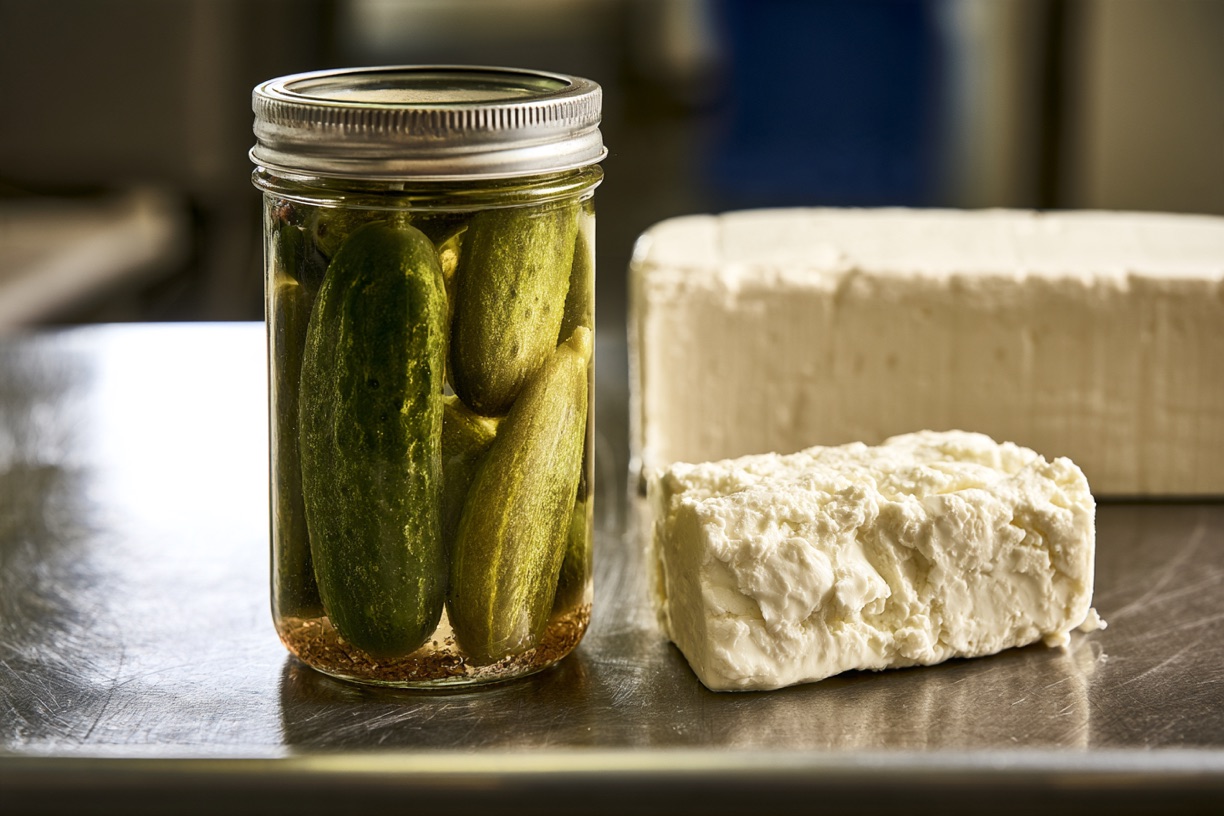
- In pickles, calcium cross-links the pectin in the cucumber cell wall, so the product stays crisp through pasteurization and shelf life.
- In cheese, calcium chloride replaces the soluble calcium that pasteurization and cold storage take out of milk, giving a firmer curd and a cleaner cut.
- Dose by calcium content. Anhydrous calcium chloride carries more calcium per kilogram than the dihydrate, so switching forms without recalculating changes the dose.
Why a pickle goes soft
A cucumber holds its crunch because pectin in the cell walls is held together by calcium bridges. Heat, enzymes and time loosen those bridges, and a pasteurized pickle can arrive at the shelf limp. Adding calcium to the brine supplies the ions that rebuild the bridges and keeps the texture.
This is why calcium chloride appears on so many pickle, relish and brined-pepper labels. It is not a flavor ingredient and not a preservative; it is a firming agent, and it is recognized as safe for that use under 21 CFR 184.1193.
Dosing a brine
Firming is a matter of calcium concentration in the brine, and the right level is set by trial for the cucumber variety, the cut and the process. Food-grade calcium chloride dissolves readily, so it is added to the brine tank with the salt and acid. Too little does nothing; too much can add a bitter note, so the dose is set by texture and taste together, within the 0.4 % (as served) that 21 CFR 184.1193 records for condiments and relishes, the category that includes pickles.
The pH of the brine still has to be right for safety and for any sorbate or benzoate in the recipe; calcium chloride does not change that part of the job.
Add it to the cover brine rather than to the cucumbers directly, so the concentration is even through the tank, and add it before any heat step. The calcium has to be in place when the pectin is most vulnerable, which is during pasteurization, not after.
What it does in the cheese vat
Milk that has been pasteurized and held cold has lost some of its soluble calcium, and a rennet set depends on that calcium. The result is a slow set, a weak curd and more fines lost to the whey. A small addition of calcium chloride to the vat restores the balance, so the curd forms faster and cuts cleanly.
US standards of identity for cheese allow calcium chloride as a coagulation aid at up to 0.02 % of the weight of the milk or other dairy ingredients, calculated as anhydrous calcium chloride, and that ceiling is also a practical guide to the order of magnitude involved: grams per hundred kilograms, not a bulk ingredient.
It is dissolved in water before it goes into the vat; added as a solid it can create local high concentrations that affect the curd.
Anhydrous or dihydrate: dose by calcium
Calcium chloride is sold as the anhydrous salt and as the dihydrate. A kilogram of anhydrous calcium chloride contains more calcium than a kilogram of the dihydrate, because the dihydrate carries two molecules of water per molecule of salt. The food-grade anhydrous pellets read for this note are specified at 94 to 97 % calcium chloride.
If a plant changes from one form to the other, the dose has to be recalculated on calcium content, or the brine or vat ends up under- or over-dosed. Write the form and the assay into the purchase specification.
| Form | Water of crystallization | Calcium chloride content | Handling |
|---|---|---|---|
| Anhydrous (pellets or granules) | None | About 94 – 97 % | Strongly hygroscopic; keep sealed |
| Dihydrate (flakes or granules) | Two molecules of water | About 75 – 80 % | Hygroscopic; keep sealed |
Both forms absorb moisture from the air and will cake or turn to liquid in an open bag.
A worked example of switching forms
Suppose a brine specification calls for 1.00 kg of anhydrous calcium chloride per tank. Anhydrous calcium chloride has a molecular weight of about 111 and the dihydrate about 147, so a kilogram of the dihydrate carries about three quarters as much calcium chloride as a kilogram of the anhydrous salt. The equivalent dihydrate dose is therefore about 1.32 kg, before any correction for the assay printed on the sheet. Run the same arithmetic in reverse when moving from dihydrate to anhydrous, or the brine ends up about a third stronger than intended.
The assay matters as well. A 94 to 97 % anhydrous product delivers slightly less than the formula weight suggests, and the specification sheet is the place to read the exact figure for the lot before the dose is set.
A short checklist
- Specify the form (anhydrous or dihydrate) and the assay; dose by calcium content.
- Dissolve before use, in the brine tank or in water for the vat.
- Set pickle firmness by trial on your own cucumbers and process, and check for bitterness at the top of the range.
- In cheese, stay within the 0.02 % of milk weight that the standards allow.
- Store sealed and dry; reseal opened bags the same day.
Frequently asked questions
- Will calcium chloride make my pickles taste salty?
- At firming levels it is well below the salt in the brine and is not perceived as salt. At high levels it can read as bitter, which is the usual sign of over-dosing.
- Can I use it in fresh cheese and cottage cheese?
- Where the standard of identity for that cheese allows it. The usual reason is the same: a faster, firmer set from pasteurized milk.
- Why did a bag turn to slush?
- Calcium chloride pulls water from the air strongly enough to dissolve in it. An opened bag left in a humid room will do exactly that. Keep it sealed and buy pack sizes you use up quickly.